2/20/2014

Albert Eddy: A missing piece and a clue to much more

I recently found a copy of “The Eddy Family in America” by Ruth Story Devereux Eddy, and was happily tracing down my line, when I found this entry (p. 364)::
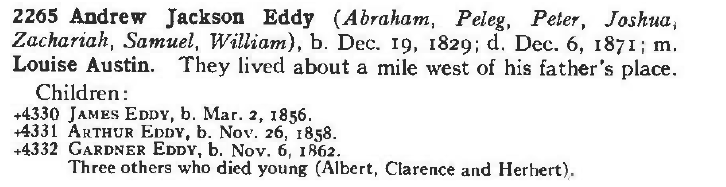
I knew about and have found a fair amount of information on Andrew Jackson Eddy, his wife (Francis) Louise Austin, and the three numbered sons listed.  I’d never heard of Albert, Clarence, or Herbert though.  This inspired me to start looking a little deeper, and I think I’ve discovered some interesting connections.  Here’s what I found.

In the 1860 Census, (Andrew) Jackson Eddy; his wife (Francis) Louisa (Louise); two sons, (James) Plunkett and Arthur; and two others Byron and Isaac Austin.  Given the similarity in ages and the shared last name, I think these are Francis Louisa/Louise Austin’s brothers.

There’s a record for Albert Eddy in "Michigan, Births, 1867-1902"  born 20 August 1868 in Berlin, Ionia, Michigan - with father: Andrew J Eddy (born in New York) and mother: Francis L Austin (born in New York).

"Michigan, Deaths, 1867-1897" has a record of Louisa Eddy dying of consumption on 11 August 1869 in Berlin, Ionia, Michigan.  It lists her parents as Daniel Austin and Sarah Austin.  This is likely Francis Louise Austin, which leaves Andrew Jackson a widower and their sons motherless.

In the 1870 Census there is an Albert Eddy (age 2) living w/ Byron Austin and his wife Margaret.  Byron is the right age, and his place of birth matches the Byron living w/ the Eddy’s in 1860.  Andrew Jackson and three of his sons; James (Plunkett), Arthur, and Gardner are listed on the previous page of the census, just three families away.

Andrew Jackson Eddy died in 1871. (I’m still working on sources for this)

By the 1880 Census, Byron and his wife Maggie have moved to Laingsburg, Shiawassee, Michigan and no longer have Albert living with them. At this point, I can’t find any further records of Albert Eddy, which would be in line with the “died early” comment that started all this.  

So, in trying to hunt down Albert Eddy I found: pretty good records of him; a likely death record for his mother, listing her parents names; and two likely uncles and an aunt - that's a pretty good haul for tracking down a missing 3rd Great Uncle.

11/04/2013

Makin’ Dinner

So, I had a pie pumpkin that I needed to use up and decided to clean it, roast the seeds, and cook a bread pudding inside it.


With a nice hot oven after I was done, I thought I’d put together some blue cheese cheesecake-style custard and bake it into a tart with some leftover mushrooms.


So, I had a pie pumpkin that I needed to use up and decided to clean it, roast the seeds, and cook a bread pudding inside it.  

I really don’t have a recipe for either, but they worked out well, and paired beautifully, so I thought I’d walk through the process of how I did it.

After cutting off the top of the pumpkin, I removed the seeds and set them aside to be cleaned and roasted.  Then I scraped out the stringy “guts”.  I filled the cavity with bread pudding I’d mixed up and let sit overnight so the bread could really soak in the custard.  Then I replaced the pumpkin top and baked the whole thing in a 325F oven for about 45 minutes in a bain marie set up in the oven.

While it cooked I put together the “cheese cake custard” using 8 oz of cream cheese, ~5 oz of BYU blue cheese, and 2 Clifford Farm eggs.  I whipped all these in my stand mixer until they were well incorporated and creamy.

I laid out a pie crust, and piled chopped mushrooms (oyster and cremini) in a rough circle in the center.  (Next time, I think I’ll add some caramelized onions and maybe some apple slices.) Then I poured the custard over the mushrooms and folded the crust up over the edges of the filling to hold things in and provide nice “look” to the whole thing.

The cheesecake tart baked for 20 minutes or so starting at 425 and being reduced to 300 after about 5 minutes.


All told, it made for a great dinner.

9/06/2012

Pâté Poulet de Campagne aux Canneberges

The other day I put together a pâté based on the pâté de campagne recipe from Charcuterie: The Craft of Salting, Smoking, and Curing — a great book, I heartily recommend it. Country style pâtés are quite easy to make. ecause of their mild liver flavor they're a good way to introduce people to pâté.

The original recipe is for a traditional pork pâté, but I had chicken and chicken livers, so I decided to go with what was on hand. Since it was my first time with the recipe, and because I was modifying it, I decided to halve the amounts. I used two indivual loaf pans to bake it in, since it would have filled less than half a terrine or a loaf pan.   I also omitted the brandy.  The (dried) cranberries were thrown in as a garnish because they seemed like a natural fit for poultry.


1 pound chicken, ground
2 oz chicken liver
4 Tbs coarsely chopped parsley
6 green onions  chopped
2 tsp minced garlic
1 Tbs kosher salt
1/2 tsp ground black pepper
1/8 tsp ground cloves
1/8 tsp ground nutmeg
1/8 tsp ground ginger
1/8 tsp ground coriander
1/4 tsp ground cinnamon
1 Tsp flour
1 large egg
1/4 cup cream
1/2 cup cranberries

Preheat oven to 300F/150C

Load liver, parsley, onions, and garlic in a blender or food processor and puree.  Combine with the ground chicken in a large bowl.  In a separate bowl mix together the  salt, spices, flour, egg, and cream. Stir this mixture into the meat and work together until it becomes a bit sticky. Finally, add the cranberries and mix them lightly into the mixture.

Line two mini loaf pans with plastic wrap, leaving enough wrap the pâtés.  Load the pâté mixture into pans, packing them down.  Fold the plastic wrap over the top, and cover the pans with foil.  (I stuck a thermometer into one of them so I could watch the temperature.

Place the pans in a casserole, and fill with hot water to 1/2 the height of the loaf pans, then bake untie the  pâté reaches 165 degrees.  (I got distracted and overcooked mine, but it turned out just fine.)

Remove the pâtés from the loaf pans, place a weight on them (I used a heavy dinner plate), and cool them overnight in the refrigerator.

They should be keep in the fridge for about a week — mine didn't last nearly that long. 


1/22/2012

Wood Badge - Back to Gilwell (again)

This summer, my wife and I are going to be staffing Wood Badge course 591-12-5!  Pollyanna will be a New Troop Guide and I'll be the Quartermaster.  We're both pretty excited.  

Going through the materials reminded me that I set some Wood Badge-like goals last year and I thought I'd better revisit them:
  • Complete "Bachelor of Commissioner Science" - I achieved this goal.  I'm now working on my MCS, and serving as registrar for a Commissioner College next month.  I have to admit, I'd forgotten about the goal, and accomplished it in spite of my lack of focus.  
  • Engage ADCs and Unit Commissioners - I blew this one.  After posting the goal, I managed to forget all about it.  Without keeping my eye on the ball, I didn't make any blog posts or send any newsletters.  I'm going to try again though - albeit with a different, but related, goal. 

Obviously, I needed a good troop guide to keep me straight.

This year I'm going to work on three goals related to my role as District Commissioner:
  • I will visit (and record in UVTS) at least three units/month at least ten months in 2012.
  • In 2012 I will try to encourage/support the unit commissioners in my district by holding at least three Basic Training for Comissioners courses.
  • I will invite the Unit Commissioners in my district to all of the Commissioner Colleges run in our council during 2012.  I'll especially focus on those who have not been trained.

It looks like Wood Badge ticket ideas are a big search term for folks landing here, so I thought I'd share some ideas that have been on my mind lately (note, these are not full-on goals, just ideas): 

For Commissioners - work with council to organize and index Commissioners College theses and get them online.
For Commissioners - work on staff at a Commissioners College or Commissioners Conference
For Commissioners - help plan and staff a basic training course for commissioners
For Commissioners - invite assigned units to attend roundtable and support their efforts 
For Scout Leaders - improve your own roundtable attendance
For Scout Leaders - invite other leaders in your own or nearby units to attend roundtable and support their efforts
For Scout Leaders - get involved in roundtable staff
For Scout Leaders - invite your unit commissioner to meetings and/or activities
For CORs - get involved in the District Committee
For CORs - help plan and staff a District Event

5/27/2011

Commissioner Training Notes - A Commissioner's Priorities

Know Your Units—Our No. 1 Priority
  • It's important to understand the chartered organization(s) you work with. You should know the COR and chartered organization head,and help understand Scouting's chartered organization concept.
  • Get to know the direct contact leaders and the unit committee members. Be a friend and be willing to serve them. Units won't open up to you until they understand how much you care.
  • You need to understand the unit's environment. What are its history, education and income level, neighborhood, etc.? How do these affect its program?
  • Don't be one-sided. Not only do you represent the district to the unit, you must also represent the unit back to the district!
Prioritize Unit Needs
  • ". . .[C]ommissioners must concentrate their Scouting time helping with specific unit needs and helping each unit become more effective with its program and operation." (Commissioner Fieldbook For Unit Service, 2010 printing, p24)
  • "Good commissioners . . . establish priority units. Priority units receive their most careful attention." (ibid)
  • "Keep a running list of needs, problems, and desirable improvements for each of your units. Highlight the most urgent needs and problems. Most people's time is limited, so concentrate your energies on the unit needs you have highlighted." (ibid)
Beware the Hazard of Diversion
  • "Because of the many programs and activities of Scouting, unit commissioners might find themselves promoting projects, carrying messages, acting as judges, running FOS campaigns, etc. While all these activities are unquestionably important, they are not the primary responsibilities of unit commissioners." (ibid)
  • Don't be afraid to say 'no' to scouting requests that will take you away from Commissioner Service.
Typical Priority Unit Needs
  • These are like the "Hurry Cases" in first aid. Units suffering from these problems need help urgently!
    1. "Unit Not Meeting. ("Stopped breathing") A unit that has stopped meeting is in serious trouble. You must move quickly to salvage the remaining leadership and membership" (ibid p29)
    2. "Unit with No Leader. ("No heartbeat") If the unit leader has quit or leaves for any reason, see that the leader is replaced quickly." (ibid p29)
    3. "Unit with No Committee. ("Choking") A unit leader with little or no adult help might not survive very long or the unit program weakens and youth get cheated out of the great opportunities of Scouting. If the committee is not working, get in touch with the chartered organization representative and explain the importance of having" (ibid p30)"
    4. "Unit with No New Members. ("Severe bleeding") Units should register new members yearround. If no new members are added and there are plenty of youth in the area, find out why the unit is not growing." (ibid p30)
    5. "Unit Conflict with the Chartered Organization. ("Poisoning by mouth") Misunderstandings sometimes occur, and they can threaten the life of a unit if left unresolved. You may need to play a neutral role; be a mediator. Help unit leaders realize that the unit belongs to the chartered organization. Help leaders of the chartered organization realize they have some responsibility for the success of the unit. Work toward bringing unit and chartered organization leaders together to talk and build some consensus about the unit. Help them get better acquainted and recognize their mutual objectives. (ibid p30)"
    6. "New Unit Leader Lacks Orientation or Training. ("Blue baby") Give the new leader preliminary information about the unit. Learn as much as you can about the new leader. Provide some basic printed materials to get him or her started. Review basic program literature.
      Have all new leaders exchange their names and contact information. Explain what other people in the unit do: The chartered organization representative represents the chartered organization, the unit committee supports the unit program and helps with administration, and assistant leaders help the leader with unit operation." (ibid p30)
    7. "Unit with Weak Leadership. ("Comatose") In almost every case, a problem unit stems from weak leadership that must be either strengthened or replaced. Remember that the unit belongs to the chartered organization, and you must not remove leaders. You do have the responsibility, though, to see that the Scouts receive a good program. Therefore, it's your duty to impress upon the chartered organization representa­tive and unit committee the importance of providing strong leadership for their Scouting unit. (ibid p30)
Steps in Solving A Problem
  • Identify the problem. — What's wrong?
  • Decide if it is a problem. — Is it really a problem, or did you catch things at a bad time?
  • Discuss the problem with the ADC. — Figure out what can be done for the unit/unit leader.
  • Is assistance needed from the district committee? — If the problem is beyond your ability to solve, what resources to you need to pull in?
  • Decide whether you will handle it alone or with the ADC. — If you need help, what role should the ADC have in bringing in other resources?
  • Decide who is to handle the problem. — If you need to pull in an expert, will he or she 'take over'? What role will the unit leaders play?
  • Plan your actions. — Make SMART goals and make sure to measure them.
  • Plan your alternatives. — Your first attempt might not work. What else are you going to have in reserve?
  • Put the plan into action. — Now that you've talked things through and made a plan, it's time to act!
  • Evaluate. — If you don't know what you were trying to do, you won't know if you suceeded. Keep records, you might find that you need these ideas again for another unit.
The Journey To Excellence Performance Award
This program replaces the Centennial Quality Unit Award, and applies to Units, Districts, and larger scouting organizations. The key points of the program are:
  • Each unit makes an annual committment, ideally at the end of the preceeding year but no later than February of the current year. This commitment is signed by the Unit Commissioner as a representative of the council.
  • In Q4 of the year, the unit determines if they have met their commitment and has the Unit Commissioner sign off on the form if they have. One copy is turned in to the district, another is turned in to the council office, and the final copy is kept by the unit.
  • There are unit level and personal recognition devices (streamers, plaques, and patches) which should be presented by the Unit Commissioner.
A Unit Commissioner is responsible to:
  • Understand the criteria, forms, and procedures for your assigned units
  • Brief the COR, committee, and leaders of the units you serve
  • Work with each unit you serve to qualify for the award. This should take place throughout the year.
  • Guide each unit through the annual review and ensure that they complete a commitment for next year.
  • Provide the appropriate recognition for each unit's achievement. Provide encouragement throughout the year as well.
  • Work closely with your ADC, District Commissioner, and/or District Executive to help the district strengthen the units you're assigned to.

Wood Badge - Back to Gilwell

Wood Badge (www.woodbadge.org) was a highlight of my adult scouting life.  It's been a couple of years since I went through the course (Go Bob Whites!), but with several friends attending Wood Badge this year, I've been reminded of what a great experience is was.

In honor of James Levao (our new OA Chapter Advisor) and many others, I thought I'd take on a couple of new tickets.
  1. Over the next year, I will complete my "Bachelors of Commissioner Science" to set a good example for the Unit Commissioners in my district, gain a deeper understanding of Commissioner Service, and be better able to serve in my new role as District Commissioner.  The timing has been really bad for me to attend Commissioner College the last several years ... no more excuses.
  2. During the next year, I will engage the ADCs and Unit Commissioners in my District with frequent blog posts (at least 8), monthly email newsletters (at least 9), and quarterly District Commissioner Staff Meetings (at least 3 — other monthly staff meetings will be at the sub-district level).
I plan on reporting on these tickets here, just to keep myself honest.  Are you a first time Wood Badge attendee?  If so, what are some of your tickets?  If not, would you like to set (and share) a goal or two for yourself and recapture some of that Wood Badge magic?

5/26/2011

What is a Unit Commissioner

Unit Commissioners are the core of commissioner service. They are the link between a unit and the district. Each Unit Commissioner is assigned three units in his or her district, which he or she is expected to visit regularly (ideally monthly, the national standard is bi-monthly). These visits might be to a unit meeting or camping trip, one on one with the unit leader, or with the unit committee. They should be tracked using the Unit Visitation Tracking System.

Feedback from the units visited should be brought back to the District or Sub-District Commissioner Staff Meeting each month. This meeting will also provide information and announcements that can be taken to units in upcoming visits. In the Rock Canyon District, we will also be sending out a monthly email with additional information. These emails (along with a companion email aimed at the ADCs) will also be posted/archived at this blog.

Unit Commissioners are BSA volunteers, and are required to get the same training other volunteers need:  Youth Protection, This is Scouting, Unit Commissioner Fast Start, and Basic Training.  The first three courses are available at myscouting.org. Additional Training is available through Commissioner College; Commissioner Conferences; and Council, District, or Sub-District Commissioner Staff Meetings.

If you have any questions or comments about Unit Commissioners, feel free to post them in comments here.

5/20/2011

ADC Letter 20 May 2011

We've got a lot of things going on in the district, and I wanted to send out a quick email to all of our ADCs to keep you all abreast of them.  Would you be interested in a monthly (or so) email with information about upcoming district events, scouting resources, and the like?

Jun 4th is National Trails Day.  We're inviting our units to participate with the Pleasant Grove Ranger District.  They are hosting an event in Orem.  The plan is to meet at the Orem Dry Canyon parking lot at 9:00 AM, and going to work on the Boneville Shoreline Trail.

Our district is hosting a National Youth Leadership Training course the week of Aug 1-6.  This is an excellent program for 12-13 year old young men.  The course covers leadership and training styles, communications, and conflict resolution.  Participants will be able to bring these skills back to their home units, and eventually take them out on their missions.  This is a great opportunity to help grow some leadership skills among the young men in your stake.  Online registration is here.

The district will hold it's annual business/rechartering meeting in August.  We invite all CORs, Commissioners, and District Committee Members to attend.  There are a number of open positions in the committee (including a Unit Commissioner for our two non-LDS units). If you have any recommendations, please send me names, interests, and contact information.  I'll see that it gets to the nominating committee.

There's a new Commissioner Award of Excellence available from the National BSA office.  The requirements are in the current Commissioner Newsletter.  We'll talk more about this at the next ADC meeting.

12/06/2010

Sausage Gravy Buns

A couple of years ago, I made up some 'pizza buns'.  I made up some pizza dough, rolled it out into a rectangle, covered it with pizza toppings, rolled it up like cinnamon buns, topped it with a bit more pizza sauce and cheese, and baked them up.  On a cold drive out to a winter camping spot, they were devoured by my troop of hungry scouts.

A couple of months ago, I saw King Arthur Flour's recipe for Quick Rise Caramel Buns.  I tried it for my family, but they were a bit put off by their 'biscuity-ness' (I thought they were fine, and even made a batch using my friend's gluten-free flour mix).

Yesterday, I was struck with a great idea.  Savory buns worked out really well, and (I thought) the biscuit style buns were pretty good -- why not combine the two?  I decided to make breakfast for dinner, and this is what I did:

I started by whipping up some sausage gravy (yeah, this is another scout camp favorite).
1# breakfast sausage

1 T butter
1/4 c flour
2 c butter milk


Fry the sausage until cooked through and lightly browned.  Try to chop up the sausage with a spatula as it cooks to create smaller chunks.  Once the sausage is done, add the butter and melt it.  Then, add the flour and mix well to create a roux of sorts.  Once you've smoothed out all the lumps, you can add the buttermilk and stir while the gravy thickens.  After the gravy is thick, add salt and pepper to taste and remove from the heat.

Now, to the biscuit/buns ...
2 c flour (plus extra for rolling it out)
1/2 c instant mashed potato flakes
4 t baking powder
1 t salt
1 large egg
1/4 c melted butter
1 c buttermilk

Grease a pie pan, and preheat your oven to 350F.

Combine the dry ingredients in a large mixing bowl, then add the egg, butter, and buttermilk.  Mix together and knead lightly.  You're looking for a smooth, not quite sticky, dough.  Turn it out onto a floured board and roll into a rectangle about 9" x 14".

Spread 1/2 of the sausage onto the biscuit dough, leaving an inch or so clear on one long edge.  Roll the dough and sausage to form a cinnamon bun like roll.  Slice it into 1-2" think slices and place into the pie pan.


Bake the buns for 25-30 minutes, or until golden brown and done.  (Internal temp should be 195F.)


During the last 10 minutes or so of baking, add another 2 cups of buttemilk to the remaining half of the gravy.  Cook over medium heat to thinken, then add salt and pepper to taste.

Separate the sausage-gravy buns onto plates, top with remaining gravy, and serve.

9/08/2010

Reading List Update 9/8/2010

The recent news that GDB now supports D makes The D Programming Language jump up a notch or two on my reading list.
I've finished 52 Loaves: One Man's Relentless Pursuit of Truth, Meaning, and a Perfect Crust, it was a fun read.  I really identified with his trip to the French monastery. It seemed like a great climax to his year, with the perfect denouement as he came home to bake his final loaves.
With a chance to get involved with a local restaurant group (not behind the counter though), the food books are still winning out in my what to read next decisions.

9/06/2010

Sunday Dinner - Sep 5, 2010

Michael's headed off to his first Homecoming Dance next week, and like overprotective parents everywhere, we wanted to know the girl he's taking. We decided the best way to do that was to invite Jane (the girl in question) and her parents over to Sunday dinner.

Pollyanna and I worked up a menu, got Michael's approval, and made the invitations. We decided on a stuffed pork loin, rot kraut, ratatouille, and rolls. Jane and her mom offered to bring a dessert. On Saturday, we headed off to Sunflower Market to pick some things up. The real fun began on Sunday though.

Pollyanna and Michael set the table and then I sent Michael into the garden for summer squash, tomatoes, red cabbage, and leeks. Pollyanna whipped up the dough for her rolls, and I put the wild rice on to simmer and chopped up some bacon to brown. Once the rice was done, I added the mushrooms and let it set for a bit.

While the rice cooled, I skinned the eggplant then chopped it, the squash, the tomatoes, a bit of garlic, some leeks, and a yellow onion. The veggies all went into my dutch oven with some kosher salt, crushed black pepper, balsamic vinegar, and olive oil.


With that in the oven, I got going on the pork loin. The first step was to cut it (jelly roll style), and lay it out. Then I brushed on a mixture of olive oil, balsamic, and a touch of liquid smoke. A touch of kosher salt and black pepper was followed with a layer of baby leeks from the garden. Next I spooned on the rice and mushrooms, spread that evenly across the top, and finished it with the chopped bacon I'd browned earlier.


I rolled the whole thing back up, rolled it tightly in foil, and popped it in the oven to start roasting alongside the ratatouille.

Next I shredded the cabbage, thinly sliced some onion and a pair of granny smith apples. I tossed the onion into a saute pan with the bacon grease and let them soften over low heat. As they started to brown, I added the apples and the cabbage and covered the whole thing. While the rot kraut softened, I mixed up some balsamic vinegar, ground cloves, and brown sugar to add a bit of extra flavor to the dish. After ten minutes or so, I added my vinegar mix, stirred everything up, and removed it from the heat.

As Pollyanna shaped the rolls, I pulled the pork loin back out, sliced it into individual servings, and put it back in the oven to finish.


The rolls went in at the same time. Fifteen minutes later, we were ready to plate and serve.

Dinner was a great success, we enjoyed meeting Jane and her family, and everyone ended up having a good time. Now, it's time to start planning next week's Sunday dinner. What are you eating these days?

8/31/2010

My Reading List on 8/31/2010

Thanks to Prentice Hall and Addison-Weseley giving me three new books, my reading list has bulked back up. Here's what I'm working through at the moment:

What are you reading? Why?

5/31/2009

Wood Badge Update 5/31/09

I'm nearly done working my ticket, and now I've been thrown a curve ball.


My tickets were mostly built around my role as Scoutmaster (though one of them had to do with my OA involvement). In January, I took over as the OA Chapter Advisor for the Lakota Chapter. Fortunately that didn't require any changes to the OA related ticket.


Last month, I was asked to take on a new role in scouting, Unit Commissioner. I handed over my scoutmaster reins to my Assistant Scoutmaster and started trying to meet the six units I'm now working with.


This means I'll have to change my ticket about doing team/unit building activities on camp-outs with my troop. I was two camp-outs away from fulfilling that requirement. I can see two options for how to move forward from here:


  1. I can broaden the ticket to doing team building activities with the units I work with. This might be imposing myself too heavily though, and it is certainly beyond my control.

  2. I could also change the focus and apply it to the OA chapter. I'm really leaning toward this one, especially since our chapter is getting close to the critical mass that it needs to really start to roll.


Even though I'm almost done with the work I signed up for, I see so many ways to stay involved with the themes that I started laying out at my Wood Badge course. I'm really glad that I made the investment to go. Now I just need to help the other leaders that I'll be working with to catch the vision and go.


If you're a scout leader and haven't been through the full BSA training program, do it. You'll be glad you did, and your scouts will be too.

1/09/2009

First Post of 2009: a look back and a look ahead

Okay, time for some catch-up. First off, I've changed responsibilities in my scout district. Gone is my angsting over how to present the best ever Boy Scout Roundtable each month. Now I get to work with the great young men in our OA chapter as the new Chapter Advisor. One of the things we've been working on is a blog to detail all of our activities and encourage our arrowmen to get out and get more active.


I'm still serving as the Scoutmaster for Troop 37. My friend and former Assistant Scoutmaster, Kevin Cole, has moved out of the area so I'm working with a new ASM and trying to build the kind of relationship there that Kevin and I enjoyed — so far, so good. Our Ward's Varsity Team isn't doing as well, but they're supposed to get a new Coach this week and I'm hoping that will help them turn the corner.


Wood Badge tickets are going well, though I need to check in on the rest of the Bob Whites from my course. Here's a quick update on each ticket:


  • Recruit Arrowmen for our chapter at BYU — I've been able to get small signs up in various areas, and have found a couple of students so far.

  • Support and Encourage Timberline (NYLT) attendance from my troop — I think I have two of my scouts (and their families) interested in going next year. I've also got three arrowmen from my chapter who are interested in serving on staff.

  • Become LNT certified — having completed my LNT Trainer course, I'm now focusing on sharing the principles of Leave No Trace whenever and wherever I can.

  • Run unity building activities at 75% of my unit's camping trips from 9/08 to 8/09. So far I'm 3 of 4, and I've got activities planned for both January's and February's trips.

  • Complete the requirements for the Physical Fitness MB — I'm midway through this, but I need to get back on track.


Klondike is coming, with a snowshoeing trek along the Great Wester Trail and more fun after that. At the Chapter level, I'm trying to get ready for lots of unit elections, a call out ceremony, and a Fellowship. It's going to be a busy time.

11/23/2008

November Campout -- Another Activity

We had a great camping trip this weekend. The Varsity Team that that has been integrated with us for the last several months cut the cord this time and we went to two separate locations. I think this was a good step for both groups. While we're both a bit smaller, we each had to take some steps to stand on our own. I can't speak for the Varsity Scouts, but the Boy Scouts certainly rose to the challenge.

In addition to enjoying the beautiful scenery at Maple Lake (and some good food -- mmmm, scotch egs make a great breakfast), we also worked on a pair of unity building activities as part of my woodbadge ticket.

The first one was a group sharing thing, as we sat around the campfire I asked each person to share a favorite scout memory. While I was interested in the answers, my bigger desire was to get everyone talking and opening up a bit about scouting and things they each enjoyed.

A bit later, we went around the fire again. This time, each scout was asked to talk about a point of the Scout Law and what it meant to him. We went around the fire a couple of times to complete all twelve points. It was interesting to hear them talk about some pretty deep topics. Neal, my Assistant Scoutmaster, and I asked leading questions when the discussion seemed to flounder. I think it was a good experience for all of us.

We also did a physical exercise. We had each boy sit in a circle, facing outwards. Then they linked elbows and stood up. It took a bit of work for them to get organised and standing, but they did it.

As we drove down and out of Payson canyon, we held a short self assessment on our recent activities, and set some goal for improvement in December. This is a great way to close out a camping trip.

10/03/2008

Great Western Trail Reports

Sometimes people ask my why I think the Order of the Arrow is an important adjunct to the Boy Scout program. There are a lot of reasons, but the biggest is that the OA provides additional opportunities for scouts to grow and learn.

Most of these opportunities come from participation in the chapter and lodge by arrowmen. Some of them are open to all scouts though. A great example of this is the Utah National Parks' Great Western Trail award. There are a number of ways to earn this ward, but all of them involve writing a 150 word report about your experience backpacking and doing service on the trail.

Getting out onto the trail is a good thing, working on a service project approved by the wilderness management agency is even better. Imagine the impact of going out and doing all of that, then coming home and writing about it to cement the ideas, memories, and insights in your mind.

Here are some excerpts from what my scouts wrote in their reports about our experiences on the trail:

Many things made me want to go on the trek. [Another scout] said it was going to be awesome. I also love to camp. And it would just be a good experience to look back on.


[I had] lots of fun backpacking with the scouts. [I liked] the big meadow where we spent both nights, it was fun. ... [Now I want to do] more, better service projects and more activities to help the community. I want to go on other parts of the Great Western Trail.


[I felt] like my service was appreciated. It makes me want to treat [the trail] with more respect than I have been doing before. ... [When I hike on other trails], I will feel much more grateful for those men, women, and children that gave up their time to make it look better and keep it clean.


I remember [our service] was hard work but the payoff was great, it was good to help the trail. It improved my outlook on [service] because of the satisfaction of doing it.


I remember cutting off all the branches on the trail hanging over and how fun it was to cut down a really big one. Ranger Polly taught us ... what to cut down and how to be safe with the [tools].


It made me see that just doing service does not mean it has to be boring, it can be really fun and cool. It made me feel good that someone ... noticed what we did.
I'm really glad that the OA put together a program that let my scouts get a better picture of what they can do ... not just in terms of backpacking and camping, but in terms of service and responsibility.

9/24/2008

More Wood Badge Thoughts (including ticket ideas)

After attending a pack meeting last night to support my wife and her wold den, and looking forward to a PLC meeting and troop meeting tonight, I find myself thinking about Wood Badge. I can't tell you how worthwhile I think the training is, but I can share with you what President Dahlquist (the LDS General Young Mens' President) said about it:

[P]repare yourselves constantly for your calling with the young men of the Aaronic Priesthood by getting properly trained for your calling. ... We encourage you to become appropriately trained so you can make the best of this wonderful resource to the priesthood. If you are new (or even if you have been in your calling for some time), yet have never been appropriately trained, go to www.scouting.org and begin your training now, online. Begin with Fast Start training, then basic and leader specific training, and then Wood Badge. ...

We are gratified with the reports from the field that priesthood leaders, including stake presidents and their counselors, bishops and their counselors, and Young Men leaders on both stake and ward levels are beginning to take the importance of this training seriously. If you haven’t already, we encourage you to sign up now for the next Wood Badge course in your council.

I think that's a pretty clear message. So, what if you're already sold on Wood Badge, and you're just looking for some ticket ideas? I can't write your tickets for you, but I'd love to share some ideas.

If you're involved with Cub Scouts:
  • How well is your unit doing with Character Connections activities? Holding these frequently and doing a good job with them will help improve packs, dens, families, and individual cub scouts.
  • Is your unit using the activity belt loop and pin program to encourage the boys to learn about athletic and academic topics beyond their rank advancement requirements? Maybe you could host an activity pin Pow Wow.
  • It can be hard for some families to help their boys earn the Bobcat award. Developing a 'Bobcat Packet' with ideas and activities could be a good project.
If you work with Boy Scouts or a Varsity Team:
  • Could your unit do something to support cub scouts? What about putting on a Webelos Woods, or hosting a Wolf, Bear, or Webelos advancement Pow Wow? Help your boys learn to love serving as they help the cubs advance along the scouting trail.
  • Does your troop provide a solid outdoor program? Year round camping, earning the national campoing award (or stepping up to the next level if you've already earned it) or incorporating hiking into your program could all be worthwhile goals.
  • Do your scouts enjoy the benefits of the Order of the Arrow? You could hold unit elections, encourage involvement in your lodge or chapter, or get involved in the OA's Scoutreach Mentoring program.
  • You could promote NYLT attendance (or encourage previous attendees to help staff an NYLT session).
No matter what kind of scouting unit you serve in:
  • You could become a merit badge counselor.
  • You could encourage adult attendance at Roundtable and/or Wood Badge.
  • You could learn about the Scout Parents program and encourage its implementation in your unit and district.
These three lists aren't exhaustive (and I left our venturing, because I just don't know enough about it), but I hope they're helpful to someone who's looking for ticket ideas.

9/18/2008

Parents' Night: Sep 2008

Last night, Troop 37 stretched themselves a little bit more. For the first time in several years, we held a parents night. 80% of our scouts were there, and all of their parents made it too. We even had a member of our chartering organization make it out.

Without having any real experience in running (or even attending) something like this, it was a big step for the boys to plan and conduct the meeting. I think they did awfully well though. Some things ran a bit long and others fell off the agenda, but we ended on time, provided some value to everyone who came, and enjoyed peach cobbler when it was over. I don't think you can ask for too much more than that.

I'm certain our next parents' night (in Mar 2009) will be better planned, better run, and better attended. I don't think I'll be any more proud of my scouts for the way they handle it or the things they talk about though.

The agenda our Senior Patrol Leader and I came up with looked like this:
  • Opening — prayer, pledge of allegiance, scout oath and law
  • Welcome the attendees
  • Review last 6 months activities — The boys ran this presentation, they focused more on the outdoor activities and less on weeknight stuff, next time I'd like to balance this better. We also ran too long, a rehearsal will probably help that next time.
  • Preview of the upcoming 6 months — I think better rehearsal, and more reliance on our program plan will help make this more useful next time. The boys did a good job though.
  • Scoutmaster's corner — I sprinted through six topics in six minutes. Hopefully it was as motivational as I wanted it to be, we'll see how many of our parents step up and get more involved.
  • Closing and refreshments — Our chartering organization representative gave us a closing prayer, and the boys served up the cobbler they made. I think we ended on a high note.
Next time, instead of a lecture format, I think it might be fun to run different stations presenting what we've done, what we're planning on doing, and how the parents can be more involved. Promoting Timberline is going to be another important goal in March.

9/17/2008

Almost an Eagle

A friend from Wood Badge sent my wife and I an email today asking for our prayers on behalf of her son, who's rapidly running out of time to earn his Eagle Scout award. This is a topic that hits close to home since I was 'almost an Eagle'. Here's my response (I've left out our friend's name and her son's, since that's not really the point).

At the time, it didn't seem like not earning my Eagle was going to cost me very much. My car, my job, and girls seemed so much more important at the time. Now, over 20 years later, I have to laugh at the thought of the Dodge Omni I drove. I don't even list my job from the time on a resume. I can't think of the last time I thought of one of the girls I went to school with. On the other hand, there are several times a month that I wish I'd put in the effort needed to earn my Eagle Scout award.

Scouting taught me many things: how to hike and camp in good weather or bad, how to work with others and how to lead them, how to cook in a dutch oven, the list goes on and on. I have lots of great memories: backpacking through Philmont, canoeing in the Boundary Waters, camping with Scouts from all over Europe, singing camp songs with 20,000 scouts at a national jamboree — but the memory that comes to mind most often is that I didn't earn my Eagle.

I feel like I owe a huge debt to the Scout leaders how helped me along — and I feel like I let them all down by quitting when the end was in sight. I could have been an Eagle Scout, but I'm not and I only have myself to blame. I wish I could help scouts today learn from my mistake. I try to encourage my son, and the scouts in my troop to keep on going, to earn their merit badges, to plan and carry out an eagle project, and to earn their Eagle.

The eagle isn't just another rank or award — it's a symbol of what you can be, it's a starting point for a life of service, it's a mark of brotherhood with the many others who have 'stuck to it' and become better for it.

Praying for [your son] is the least I can do. If you think it will help, please let him know how important I think earning his eagle will be.

Tri-Council Varsity Challenge

Over this last weekend, my son and I went to the Tri-Council Varsity Challenge. He was the only member of his team that wanted to go, so I worked out a deal with another team. Mike would go with them and I'd come along as a second leader, only the backed out a couple of days before the trip. I wish both groups had gone, it was a great activity.

I got to meet an internet friend, Dave Muncey, face to face. We sat at the feet or Pres Burgess (1st Counselor in the LDS Young Men's Presidency) and were taught about the importance of Scouting and the Varsity Program. We had fun at the opening concert (Jon Schmidt and his son's band "Painting the Finish Line". And all that happened on the first night.

Things got more involved the second day. Saturday kicked off with a ~4,500 scout glag ceremony. After that, we moved on to a series of activities that highlighted the five areas of emphasis in the Varisty Program:
  • Advancement
  • High Adventure/Sports
  • Service
  • Special Programs and Events
  • Personal Development
Most of the activities were things that could be brought back into a unit and expanded on over the course of one or more meetings. It was really neat to see examples of things that could be mixed into a Varsity Team's schedule to add a bit more excitement.

If you weren't there, you missed out. I sure hope they do something similar next year, I'd love to go again -- only this time I'm going to do a better job selling it to the Varsity Teams I interact with.